
nightmind.
A nighttime story about insomnia, uncertainty, and waiting for answers.

Length: 3,510 words
Oh hell, not again.
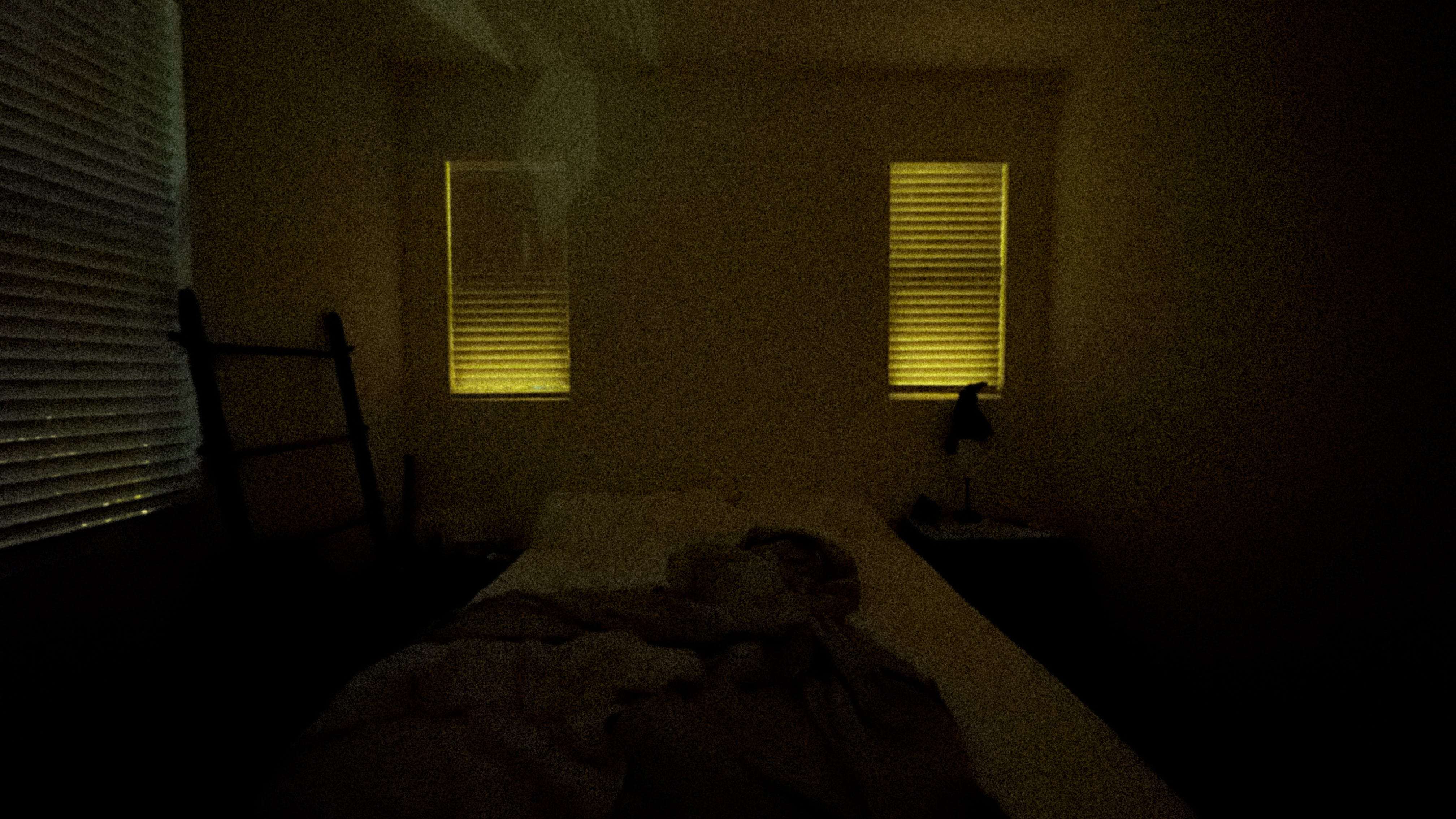
I’m awake before I want to be awake. The room is still nearly dark, save for the piss-yellow light streaming in from the street lamps outside. Beside me, a soft snoring. Glad he doesn’t snore so loud, I said to myself when we first met. But here and now at 3 a.m., that same gratitude has become a grating reminder that sleep is happening elsewhere, without me.
Go back to sleep, I tell the body. It does not listen. Stop thinking, I tell the mind. It doubles down in defiance.
It is never clear when it begins. Only that at some point my thoughts start moving faster than my own consciousness can follow. By the time I catch on, my mind is no longer mine to direct.
It abruptly pulls my mom into focus, reminding me that I haven’t called her in some time.
You don’t need to tell me she’s getting older, I already know. I see the evidence of time passing on her face. “Hah? What you say?” she asks. I repeat myself, a little louder, a little slower.
She often asks me to visit, and I say I will. Of course I will. Months have gone by.
I’m a bad daughter.
Will I remember to call in the morning? Should I email myself a note?
Don’t forget. Don’t forget.
Because that’s what bad daughters do: they forget, and then they keep on forgetting.
This is what you woke me up to tell me? Screw this, I’m going back to sleep.
I close my eyes and imagine I could grip sleep by the throat and drag it back into my body. What happens instead is this: the room, the bed, and snoring dissolve, and I’m back at yesterday’s lunch. Only I’m not in it, not really. I’m watching myself, other-me, as she comments on the restaurant’s interior.
“The cutlery is so heavy!” other-me exclaims in amazement as she balances a butter knife on her palm.
It is during this same lunch with weighty cutlery and overly salted Peruvian-Chinese food that my friend confesses she’s still struggling with her book. Even after a creative writing retreat. Even after several drafts. Months of trying and still...
I know what other-me is about to say before she says it. There’s still time to stop it.
“Guess what...” the words start to tumble out.
There isn’t.
“That’s just the creative process!”
As I lie there in bed, watching other-me smile like she’s offered something helpful, the words land heavier. Like a thud of shame that arrives too slow, too late. The regret, too, waits until now to show. Maybe that’s mercy.
A real friend would have listened longer. Asked better questions.
You could have said: Tell me more.
You could have asked: What’s got you stuck?
You could have just shut up.
Instead, you came in hot with…that. How trite. Dismissive. Useless.
She’s never going to talk to you again.
How long have I been awake now? Twenty minutes? An hour? Three?
It matters because then I’ll know how disappointed I should feel about failing to fall back asleep. Fucking sleep, dammit. Did I do it? Did it work? The only problem is, I often cannot tell if I’ve slept unless I’ve dreamt.
They call this insomnia.
I call it a nightly hell loop.
But what do you call it when you lose custody of your own mind between the hours of 2 and 6 a.m.?
When every thought that made perfect sense during the day reanimate as judgment during the night?
I know what to call this: The nightmind.
If I name it, is it mine?
If I could will sleep to come, I would’ve mastered it by now. I would plead with it, negotiate with it. I’d promise it anything: no more late afternoon coffees. No more screen time an hour before bed. I’d be a better daughter. A better friend.
If I could will sleep to come, I’d have my mind intact. It would be my own.
But sleep never comes when I will it or bargain with it, and most nights I find myself stuck between aching for sleep and trying to control it as if it were an on/off switch. It is not.
It is the nightmind that lives here, in the hours no one else sees.
Because I do not sleep, it doesn’t either. Instead, it prepares for events like they’re fire drills. It asks, “Which memory should we be embarrassed about tonight?” It besieges me with a list of concerns that feel, in that moment, of great cosmic importance:
How can someone “do sleep” wrong? Is this my life forever?
Shoot, did I close the garage door?
Why did I say “you too” to the waiter?
Damn, I forgot to call my mom again.
I should wash the towels in the guest bathroom.
I feel like I’m forgetting something else...
It’s not as though the night invents new problems or fears. It reveals all that was already there. The ordinary things and the everyday fragility. Night strips away the luxury of distractions from the day (work, to-dos, eating, TV shows, scrolling), leaving you alone, finally, in the dead quiet with your own mind. With the possibility that the ordinary is not safe.
The nightmind thrives here.
It insists on vigilance. On always knowing and staying in control. And I suppose that’s the problem: vigilance doesn’t sleep. It doesn’t need rest. Yet I do.
I’ve struggled with insomnia for many years, and with it comes the nightmind. Perhaps (un)luckily for me, it comes and goes like a weather system. I had just clawed myself out of the worst of it a few years ago, and now it’s here again. Like an old friend who shows up uninvited, assuring you their stay is “only temporary” but two months later, there they still are — and all your favorite snacks are gone.
There’s supposedly a reason it comes and stays, and that reason usually only reveals itself in hindsight — when you’re somewhere past the bleary daytime delirium but before you stop fearing nighttime.
I’m convinced it has an uncanny instinct for disturbances in your life. It tends to circle the same things: conversations where something slipped out you can’t take back; careers you don’t realize are hollowing you out until it’s too late; relationships that ask for a version of you that’s unsustainable.
Always something just a little off.
The last time it showed up, I was running a business that no longer aligned with me. I wasn’t sure then, but I’m sure of it now: it knew the jig was up before I did. And once I left that life, the worst of my insomnia left too.
This time, I think I know what it came back for.
For what greater disturbance is there than having your own mortality placed right in front of you?
One day in July 2025, I discovered a lump in my left breast.
Not out of vigilance, ironically. It was purely by happenstance, after my partner found a lump of his own (it was nothing). When my fingers landed on that irregularly shaped, almost rubbery mass, I wasn’t sure at first. How could anyone be? I checked my right breast in the same spot, then checked my left, went back to my right, and then back again. There was definitely something different there.
We wanted to believe that my something was nothing. And statistically speaking, given my age, nothing was likely. A quick appointment with Dr. Google informed me it could be tissue expanding and contracting according to hormone fluctuations, an explanation I much preferred over grimmer alternatives.
Except I now know it wasn’t hormone fluctuations. But before that knowledge revealed itself, the question remained: If it wasn’t hormone fluctuations, what else could it be?
It took another four months for medicine to give me answers with any degree of certainty.
Four months for the nightmind to grasp at any morsel of information — an abnormal mammogram, an ambiguous biopsy (“It’s benign but we’re also not sure it’s not malignant”), an MRI that yielded no further information, the anticipation of a looming surgery — and turn them over and over, trying to wring certainty out of incomplete information. Trying to find comfort in the least likely of places to find it.
Biology doesn’t make itself knowable or more certain just because I demanded it, apparently.
I’m so young. It’s nothing, right?
What if it IS something? I’m so young!
Look, there’s nothing else I could do right now, so just sleep. ...Okay?
So, what happens when a mind wired to know — and to solve — encounters something it cannot know and cannot solve (at least not immediately)?
I already know what happens.
The nightmind steps in and prepares for the worst. It keeps one eye open at all times.
It prolongs the standoff between a body that wants rest and a mind that believes rest is negligence.
Could I have done something different?
What if I never found my lump? What if it’s already too late?
I need to sleep. SLEEP!
No matter how many test results arrived or how well I researched my questions, clear answers lingered just beyond reach. Even when there were answers, they came packaged with doubt, with risks, with probabilistic outcomes. Doctors are careful with their language. They always hedge. So many sentences would begin the same way: “There’s a non-zero chance that...”
This wasn’t how modern medicine was supposed to work. I just wanted a yes or no. Cancer or not cancer.
But all I was handed in multi-page stapled reports were likelihoods, “non-zero” maybes, and ambiguity layered onto uncertainty.
What do you do with uncertainty?
Can you measure it? Put it in your calendar? Force it into yes-no binaries?
Twice during these months, I had to fill out medical questionnaires and found myself stumped by one particular question:
“Any recent changes to your health?” these forms would insist on knowing.
“Check Yes or No.”
It was not a difficult question and yet it was.
“No,” I would lie as life all around me kept moving, and I was the one frozen in place, hovering between “benign” and “not benign,” between “nothing” and “non-zero.” Not sick enough to claim catastrophe, not well enough to relax.
What box do you check while you wait?
All of life is uncertain, we’re told. The stock market could crash tomorrow! The house you’d planned to grow old in could burn down in one wildfire season! You could wake at 3 a.m. and not fall back asleep! The body you’ve trusted for decades could silently turn on you.
The future, perpetually unknowable.
We’re to believe that this knowledge makes tragedy bearable. But there is little comfort in the certainty of that uncertainty. Not when the stakes are this high. And certainly not for someone like me who believes that everything can be fixed.
I’m the kind of person who believes that you can brute-force problems with enough deduction and effort. Give me a problem and I will reduce it to its smallest constituents, find a clever solution, and make it more efficient, even if no one asked me to.
I will fix it. I have to.
This instinct has served me well. Until it met insomnia. Then this mystery lump.
Of course I’ve already tried solutions for better sleep: chamomile tea, meditation, cognitive behavioral therapy, magnesium, melatonin, sleep trackers, blue-light blockers, UV light bulbs.
The fact that my insomnia persists despite these interventions feels like a sort of private failure, evidence of some fundamental brokenness. As if poor sleep were a moral flaw. As if it reflected a bad temper. A lack of effort.
Both sleep and lumps, it turns out, are problems that do not improve with effort (paradoxically, the harder you try to “solve” sleep, the further away it gets). They do not bend to great techniques and solutions, nor do they resolve on a timeline that matches your ambition.
I had all of this “problem-solving energy” humming below the surface but nowhere to direct it. If I couldn’t fix something, what was I supposed to do instead?
Oh, I suppose the living room could be transformed into a cozier space with a vinyl player and warmer lights. Why yes, let’s add more plants to the office and rearrange the furniture there too! Excuse me while I purge my closet and sew a crossbody bag from scratch.
The solving energy wants to home in on all the things it could win. Problems that actually yielded to effort, each providing a momentary release valve but never touching the thing that actually mattered.
How much knowing is enough to let a life continue?
Finally, after four long months, after the long stretch of unknowing, certainty — and a problem to solve — arrived.
I was diagnosed with early stage breast cancer.
The benign-not-benign lump turned out to be not nothing, after all.
Unambiguously. Definitively. Not maybe.
I know now. And I wish I didn’t.
Far from feeling relief, the arrival of the cancer diagnosis landed like a judgment for all of the decisions and wrongdoings in my life. The time I stole a packet of pens from the store when I was eight years old. When I yelled at my mom once on her birthday. Or all the homeless people I ever ignored, too many begging for change.
Didn’t I eat enough fruits and vegetables? Avoid smoking? I exercise five to six times per week, for crying out loud!
And yet.
Instead of sound sleep, I spent many nights still in the throes of a now-louder nightmind, not because of a moral flaw, a bad temper, or a lack of effort, but because I had longed for uncertainty to end and was now facing the fallout of that wish.
My mistake was in thinking that certainty would quiet the nightmind. I thought that once the answers arrived, the waiting would end and sleep would finally return.
I can’t believe I have cancer.
I thought I did everything right and still...
How could this happen to me?
During the whole time I was waiting for more results and for my life to resume “as normal,” I latched onto The X-Files. Somehow this beloved show from the ‘90s kept me afloat. I’d hit play, hum the iconic theme song, and let Agents Mulder and Scully argue about aliens or the Chupacabra or the Loch Ness while my own body remained an unresolved case.
In particular, I found myself drawn to Mulder’s obsession with chasing the answers to questions that would ruin him: Is his sister alive? Or dead? Are aliens real?
I now recognize the comfort in having something to chase. Because if he ever truly knew, if his search for certainty ever came to an end...
What would Mulder have left?
As long as there was something to chase, there was still something to do.
For months uncertainty had been propelling me forward — appointments, scans, surgeries, second opinions. At least with ambiguity you can argue with it. You could convince yourself that probability had wiggle room.
As long as the answer wasn’t final, there was still a version of the story where this wasn’t happening to me.
“But why bother with diagnoses at all, if a diagnosis is but a restatement of the problem?” wrote Maggie Nelson in Bluets.
A diagnosis should feel like progress. As if it were a doorway I have been waiting to step through to enter clarity, action, and forward movement.
Except a diagnosis is not a doorway. It is a sign hung slightly askew over what had always been true: The cells were already mutating. The lump was already there. My body already made its decision — years ago, in fact.
Now it just has a formal label.
If anything, the certainty kicked down the last illusion, the illusion that all I was waiting for was an answer. I know now that was only partly true. What I was actually waiting for was the feeling of safety that I believed the answer would bring.
A permission to return to the life I once knew.
For months I have told people that I was working on an essay about insomnia, without writing a single word. I’ve sat at my desk, occasionally opening the same document and just staring at it long enough to prove to myself that I was trying, then closing it before a sentence could expose me. It was my way of clinging to life as it was, before all of this.
But like sleep, creativity doesn’t come just because I’ve willed it. In this way, insomnia and writer’s block are the same because once you’ve been afflicted, you begin to wonder if either will ever return.
“That’s just the creative process!”
I had said it so easily, thinking that naming it would make it survivable. Thinking that, within the creative struggle, I would find the permission I was looking for.
Except no person, diagnosis, or essay could give me that.
I was asking to return to a life that no longer existed, a timeline forever closed to me the moment I found the lump.
And so the anxiety persists.
The illness persists.
The nightmind most of all — talking and talking, never stopping.
“It’s been said that the fear of the unknown is an irrational response to the excesses of the imagination, but our fear of the everyday...is as frightening as any X-File, as real as the acceptance that it could happen to you.”
I had earmarked this quote from Agent Mulder the moment I’d heard it. I didn’t know why at the time — only that it stirred something. I get it now.
It turns out that the nightmind doesn’t fear monsters but the everyday turning against you: how my mom asks me to repeat myself; the way biology reveals itself quietly, slowly, then suddenly; and how simply not writing could keep you frozen in time.
Your own body and mind.
On the worst sleepless nights, when I lie there and let the nightmind run its drills, I can feel the engine of it humming along — scanning, analyzing, anticipating pain and loss. It believes this is how we live.
This is how we prevent ourselves from being blindsided by the inevitable. Always solving, always keeping one eye open.
In other areas of life, that instinct is sound. There is a proportionate relationship between effort and reward. If I worked harder, I’d get more clients, make more money. If I lift heavier, I’d grow stronger. If I mapped all the potential problems, I’d be safer. Analyze, optimize, execute — and outcomes would follow, all of it reinforcing the very idea that effort produces reward. That vigilance pays.
In those areas, it did. Vigilance felt like protection. Like I had control over my sleep, my life, and my body.
That was a core operating belief for most of my life.
And then sleep did what it wanted. And my body did what it wanted. And then creativity did what it wanted.
What did all of the hundreds of sleepless nights amount to? The nightmind never prevented disaster. The constant vigilance and control never reduced uncertainty. Just fear, wide awake.
And I’m the one left exhausted.
I’m the one with cancer.
I understand that, on an intellectual level, so much of life sits outside my axis of influence. No matter how many green juices I drink, cells will still do their thing. Whether I call or don’t call, my parents will still age. And despite my desperation, sleep will still not come on command.
But understanding is not the same thing as accepting.
Because I’m not just trying to sleep, I’m trying to prove I’m still “productive,” still useful in the day-to-day.
I’m not just trying to remember to call my mom, I’m trying to get ahead of the regret I’ll feel when it’s too late.
And I’m not just trying to write an essay, I’m trying to come back to the version of me that existed before the diagnosis. The one who would write her way through. The one who assumed continuity.
Well, I’ve written.
But I am not back.
I am here.
It is morning now. The sky is beginning to lighten, bringing the outlines of the room’s dresser and tower fan back into focus. Beside me, I still hear the sound of soft, steady snoring.
Nothing has been fixed. The body still carries what it carries, and I have not slept. If I did, I cannot remember because I have not dreamt.
The day is coming all the same.
The nightmind will follow.
Author’s note: As of publication, the cancer has been treated and the prognosis is good. At present, I’m cancer-free. I’ll continue publishing here and on YouTube. ✊
Wow…I feel for you. What did Buddha say about life? All life is suffering and that it’s our attachments that cause the suffering? Trying so hard to be, to do something, to be perfect. It’s crushing. I wish for you peace of mind and heart. I’ve always enjoyed you from the beginning. Hang in there Stephanie.
This moved me beyond words Stephanie. Your writing bleeds of raw emotion and truth. My heart goes out to you.