
Why does Substack think "Substack" is spelled wrong on Substack?
I thought this meant one thing, but I kept going, and oh no...

Length: 3,014 words
I noticed it last year, when I’d started publishing here.
At first, it struck me as nothing more than profoundly amusing. A funny little observation.
Here was Substack — a platform built for writers and writing itself — with its own text editor insisting that “Substack” was a misspelling. A not-real word.
Every time I typed it, the name appeared with a red squiggly line underneath it, as though the platform itself wasn’t entirely convinced it really existed.
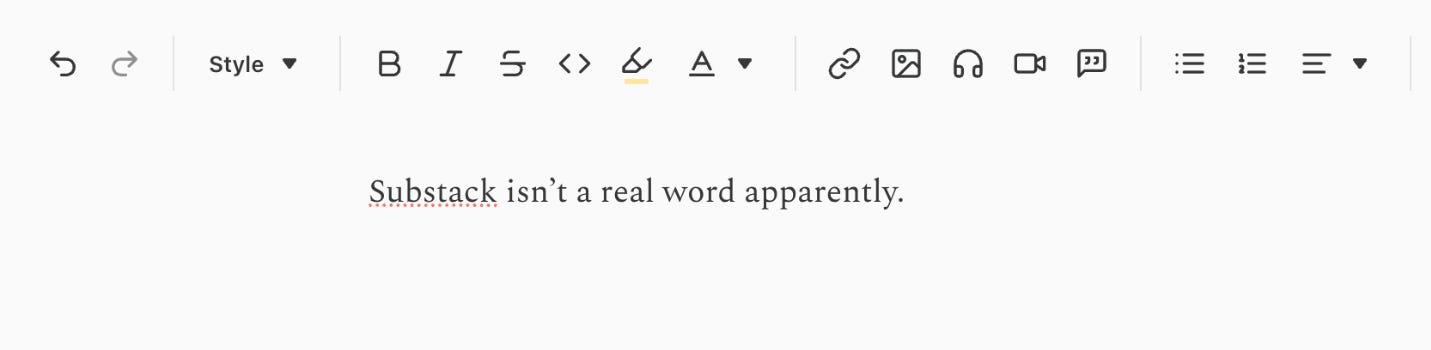
“Somebody tell Substack they’re a real boy!” I’d written with a bemused chuckle in one of my documents, the sort that catches stray thoughts before they’re spirited away by distraction and a growingly unreliable memory.
I forgot about it anyway.
Or rather, I forgot until I didn’t.
Every time I return to the editor to publish something that mentions Substack, there it is again, the red squiggly.
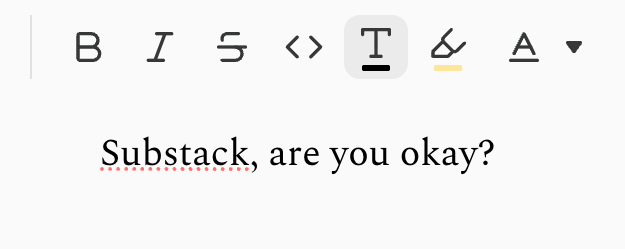
“Substack” is correct. Yet Substack’s editor says it is not.
Who do we believe?
I nearly let it go again when I saw it recently, but something in my temperament must’ve changed that day. Maybe it was the particular gloom of the clouds that morning, or the fact that I took my vitamins before I drank my coffee instead of the other way around.
In any case, after a while, certain observations refuse to stay small. This one in particular became bigger and more bizarre the moment I started to chase it with the seriousness of a detective investigating a murder.
After all, there are questions. Inconsistencies.
It’s not as if Substack is the new kid on the block anymore. The platform is, by my calculations, eight years old. Not old-old, certainly, but old enough that one might reasonably expect it to recognize its own name. The fact that it failed to do so made me curious:
If Substack’s own text editor puts Substack under suspicion, presumably because it thinks we mean to write something else, how would it respond to other startups and company names?
So I typed some out. One by one.
A mixture of older and younger companies, big and small.
Google. Microsoft. Claude. All the way to WriteSonic.
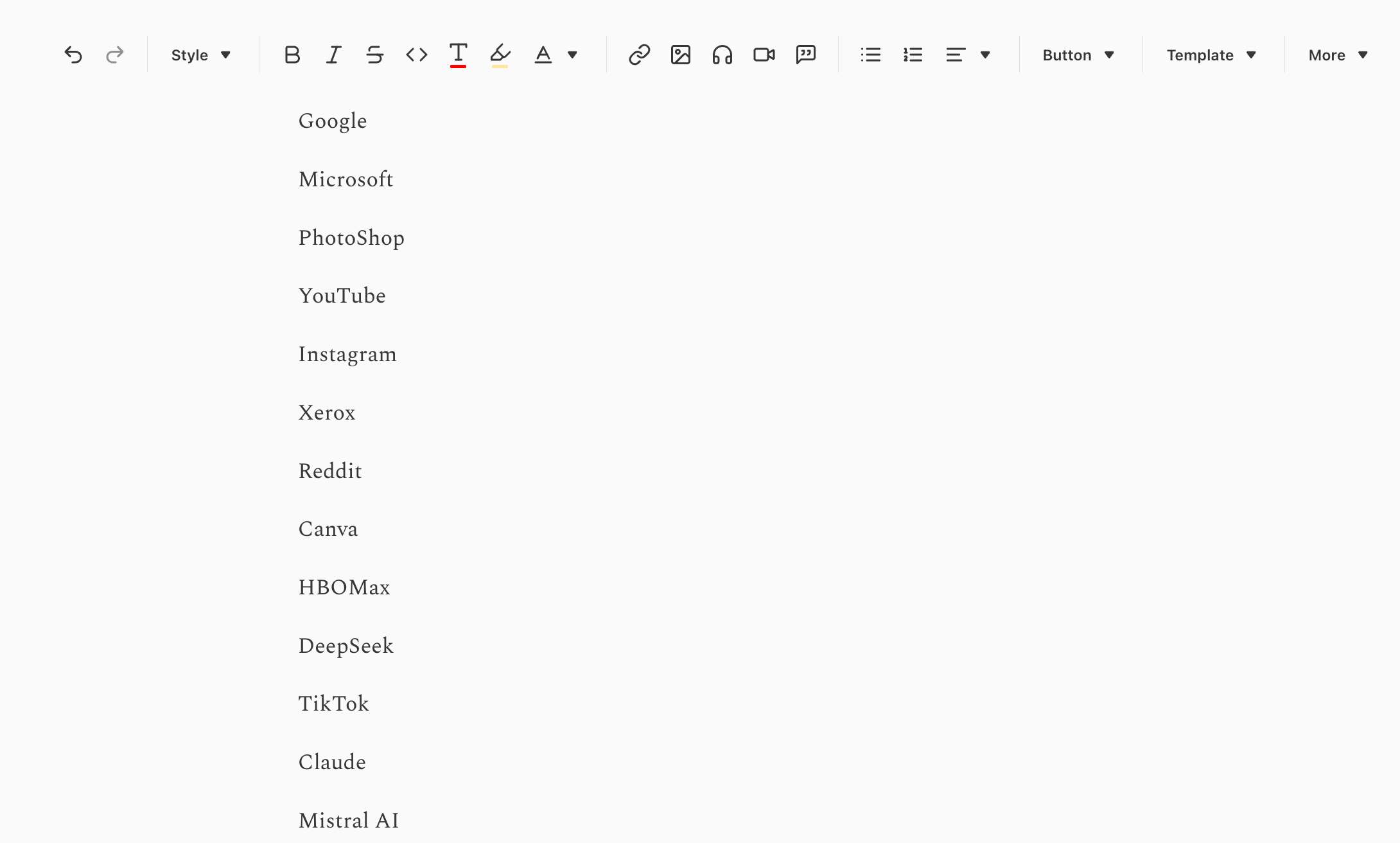
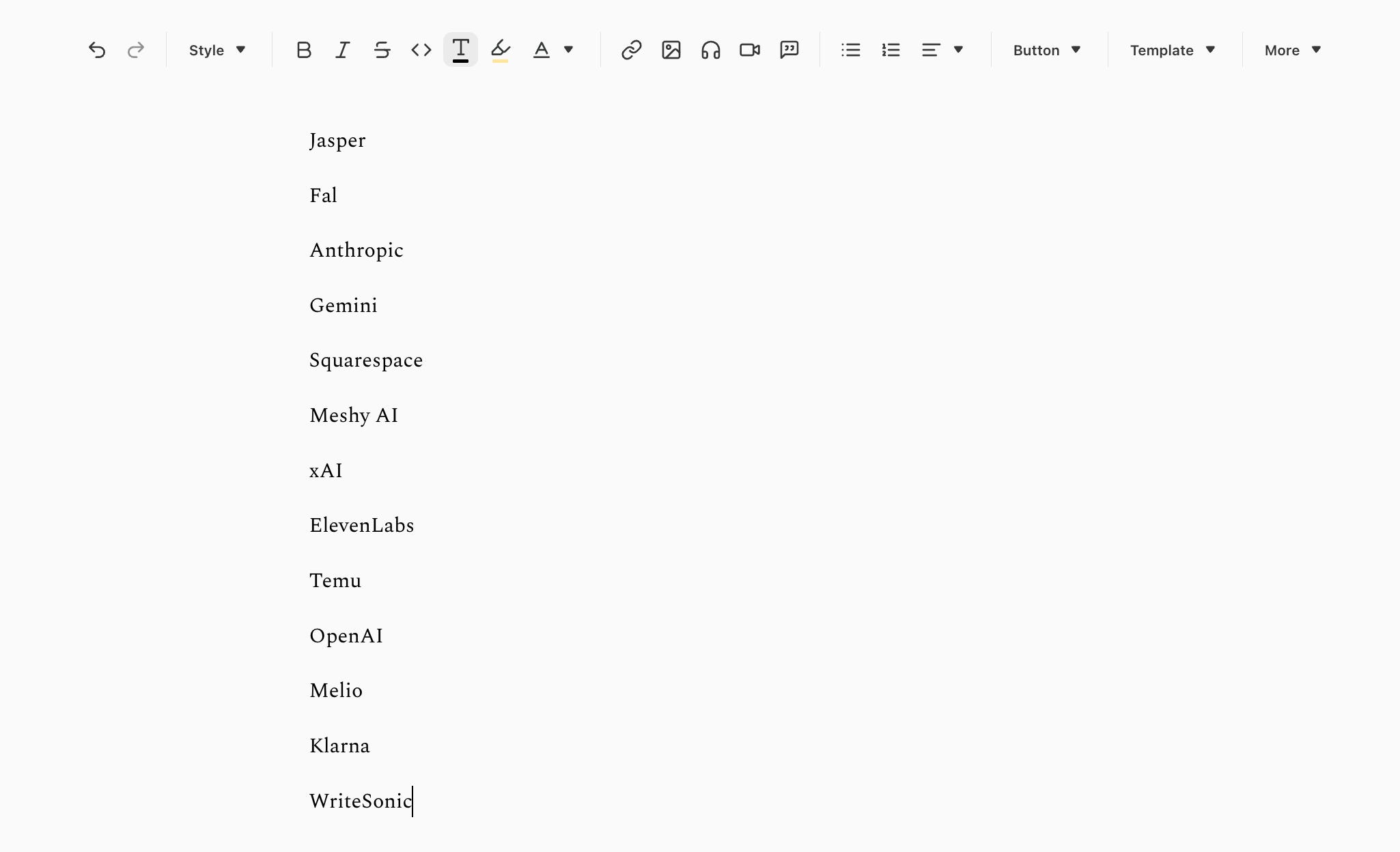
All of these names, none attached to a red squiggly.
All of these names, deemed correct.
Here stood Substack, inexplicably alone, painted red with the equivalent of a giant question mark.
Not even HBO, a company that has reincarnated more times than anyone asked for, is that unsure of itself. Then there are companies like Claude, DeepSeek, and Meshy AI that have been born only in the last few years — and even they have somehow been admitted into the pantheon of Acceptable Words by the editor.
I could understand the impulse to check the spelling against the actual site in case there was an overlooked hyphen or some deliberately butchered spelling, but I assure you that Substack is “Substack.”
For whatever reason, “Substack” seems particularly controversial — on its very own platform!
I wonder what the red squiggly is indicating. Perhaps it’s asking, with a sincerity that comes with genuinely trying to be helpful:
Did you mean “substance”? Did you mean “subpar”? Perhaps simply “stack”?
Surely, someone would know.
Surely, the answer would lie in Substack itself.
“How can I help you with Substack today?” Substack’s chatbot asks.
Oh, Mr. Chatbot. I’m afraid this is no ordinary customer support inquiry.
I carefully lay out the facts of the case: “Substack,” misspelled; on Substack’s own editor; many other company names, fine. I crack my knuckles and wait, my anticipation of its response beginning to match my imagination’s gumption.
I imagine the chatbot letting out the machine equivalent of a gasp, then sounding the alarm at Substack headquarters, prompting all engineers to immediately abandon their posts and march single-file into a conference room, faces grim.
“My god,” one mutters in a gravelly voice, “Substack doesn’t recognize Substack.”
Eyes widen, murmurs erupt, an intern faints, and before long the matter is escalated all the way to the top, where one executive slams a big red panic button and the entire website simply implodes.
“Thanks for bringing this to our attention,” it replies with all the concern of a bored high school kid working a summer job. “The issue is not with Substack.”
It goes on to explain that the issue resides elsewhere: in my browser settings, my browser itself, or my own device.
Wait.
Only me?
No one else sees the squiggly?
I’ve spent the better part of a year observing a phenomenon that, according to one source, was never even a thing?
Unlike the spellchecker, the chatbot seemed so sanguine, so certain. I had to make sure I wasn’t being gaslit by a machine.
Firefox. Safari. Chrome. iPhones. Androids. MacBooks. PCs. Different accounts.
I verify “Substack” across all these, and sure enough, the squiggly squiggles on.
“Would you like me to help you file a bug report?” it asks just as coolly and unperturbed, only now convinced that there is a problem at all.
You smug son of a…
But I couldn’t be bothered with it, as my mind is elsewhere now.
Because if the problem isn’t unique to me, and Substack itself is insisting that the problem originates elsewhere, then who exactly is accusing Substack of not being Substack?
More importantly, why?
Has nobody informed this unseen authority that the platform is eight years old (almost nine!)?
Do they know about the tens of millions of users?
Its “unicorn” status?
The hundreds of millions of dollars?
The best-selling authors? The renowned publications? The writers who have built entire careers here?
By all observable measures of reality, Substack is indeed a real boy!
Perhaps more bewildering still:
Why am I becoming increasingly concerned on behalf of a billion-dollar platform that most definitely has more important things to address?
At this point I begin to suspect that I am not really thinking about the spellchecker anymore.
No.
We’ve long since left the atmosphere, apparently.
Some time over the course of this investigation, the red squiggly no longer struck me as simply amusing. Sometimes when you stare at something long enough, you eventually stop seeing what’s there and start seeing something else. Clouds are only floating droplets of water until they become dinosaurs. A Rorschach test is only ink until someone sees Elvis.
And “Substack” is only a misspelling until even that falls away and in its place something unexpected emerges.
A mirror.
Substack? Are you sure you don’t mean “substantial”? Or “haystack”?
As if this platform has somehow been infected with the same tendency toward self-doubt as the people who use it.
Always hoping to be understood. Frequently wondering if they’re a fraud.
Despite all that they do and have done.
It’s difficult not to notice the resemblance.
To us.
Writers.
Are we not constantly accompanied by our own metaphorical red squigglies?
The writer with less than 100 subscribers.
The writer who quit a respectable career to bet on their passion.
The writer with thousands of words languishing in Apple Notes.
A whole ecosystem of people who live up to their title every day probably being asked the same question the editor seems to be asking about Substack:
Writer?
Are you sure you don’t mean “doctor”? Or “engineer”? Or perhaps “paleobotanist”?
As if being a writer meant moving through the world like a sleepwalker, unconscious of the more sensible alternatives, and sooner or later one might finally wake up and come to one’s senses.
Some version of this question has followed me all my life. Before the internet, before I was old enough to even understand what it meant. Perhaps that’s why this red squiggly stood out to me.
As I’ve gotten older, the question comes up a lot less, though when it does, the words themselves change (of course they do). And every now and then it returns with the uncanny familiarity of a song you might not have heard in years.
“Wow, following your passion is so brave.”
“Oh, you’re still doing that?”
“Maybe have a backup plan.”
It takes only the first few notes before I know exactly how the chorus goes:
Writer? Are you sure?
Because what I know of the word “writer” is what I know of secrets. It is no secret that I am a writer, yet the word has never sat comfortably in my mouth. Looking back through my career, I’ve caught myself performing little acts of linguistic origami around the word “writer.”
Instead of writer, I’ve called myself a journalist.
Instead of writer, I’ve called myself a media strategist.
A columnist. A newsletter operator.
An essayist.
Hell, a professional overthinker.
Anything, apparently, but writer.
As though the plainness of the word by itself carries too much pretension. Too much vulnerability. Too much possibility of it being misunderstood.
Too...naked.
All those other ways to call myself a writer, at least, say something that “writer” doesn’t.
A journalist suggests that the writing itself matters.
An essayist makes the writing sound elevated, literary.
A media strategist conveys Serious Business.
A professional overthinker breaks the ice.
Each word a better disguise, each a better container that carried with it an importance I feared “writer” by itself lacked. But now, I recognize them all for what they really are.
Armor.
And might I add that there’s something deliciously ironic about all this.
Ironic because, for the better part of a decade, I helped other writers with far more subscribers — many with books too — present themselves to the world with the proper adornments attached to their name:
“Best-selling author”
“As seen in...”
“Trusted by...”
“Read by millions”
“New York Times best-seller”
It never occurred to me to question whether those adornments were what made them writers.
Nor, for that matter, did I ever think to ask my doctor to show me his New York Times best-seller. Or my engineer friend to prove that she was indeed trusted by millions.
No.
That level of scrutiny was reserved almost exclusively for me.
Did you mean “content creator”? Or “storyteller”? Or “purveyor of prose and narrative structure”?
It’s unsettling to admit now that I may have inadvertently spent my entire career putting a red squiggly under my own name.
And then proceeded to collect evidence from readers, publishers, clients, and ghosts, acting as though if I collected enough of it an imaginary tribunal of Very Serious Persons would descend from the heavens and settle the matter once and for all.
And then, the red squiggly under my name could finally go.
Who do we believe?
Thinking more deeply about it now, I don’t think this fear I have is about talent. Or originality. Or even accomplishments.
Rather, a fear that I have made a terrible mistake leaving a respectable business to fully embrace what I’ve always loved.
That I am the only one who thinks this is all worth it.
That this magnificent compulsion to arrange words and spend years doing it is regarded as nothing more than a “little passion project.”
The closest word I have for this is legitimacy.
At least, that’s the word I keep returning to.
Because I have this idea stuck in my head that this vocation of mine only counts once I get to tell people “I’m a best-selling author” or “I have a very popular newsletter.” For without the armor or adornments, I fear the whole thing looks like foolishness.
For without armor, without adornments, “writer” is all I have left.
Not long ago, at a friend’s 40th birthday party, I heard it again, that song. Enough time had passed, I suppose, for me to think I’d stopped listening for it. Then someone, presumably making small talk, asked:
“So what do you do?”
Here we go.
“Oh, I’m a writer. I write about personal experiences and things I find fascinating.”
“Cool, like books?”
“No, not quite, they’re essays on a platform called Substack.”
“Oh, Sub—what? I haven’t heard of it... Well, that’s cool.”
Well, that’s cool.
There it was again.
Not the question, not the harmless banality of the conversation. I mean the reflex. The feeling that the word “writer” somehow changed meaning as soon as it left my mouth. Into neither a profession nor a confession.
But an apology.
Nobody had asked for one, and here it was anyway.
Sorry if I’m afraid to sound like yet another overcaffeinated creative who’s posted up in coffee shops around Los Angeles, indiscriminately unloading their finger guns on innocents, still working on the same screenplay for the last six years.
Sorry if I get overly enthusiastic about ideas that don’t exist yet, floating half-formed, because I’m still working them out too.
Sorry if this all sounds like I am just unemployed.
Sorry if I’m the only one who believes this is heading somewhere.
I’m not apologizing merely because I’m sorry.
I’m apologizing because apologizing pays.
Apologizing becomes the price for remaining what I am.
A writer.
Words are funny things.
At some point, enough people use a combination of sounds often enough until the rest of us collectively agree that, yes, this precise arrangement of letters seems real. Then, lagging behind the culture, institutions like dictionaries eventually catch up.
The Oxford English Dictionary added “rizz” in 2023, years after the word had already left everyone over the age of 30 thoroughly stupefied. Merriam-Webster added “doomscroll” in 2025, despite the rest of us having already spent the past decade perfecting the art.
Institutions record the verdict. They do not render it.
That, I later learned, is how Substack’s own spellchecker actually works — assembled piecemeal and added to by everyday users. Substack appears to leave the decision of which words to legitimize up to us, then expects us to manually add those words to our browser’s or built-in device’s dictionary (not everyone does this, apparently).
Recognition, then, doesn’t make something legitimate. It merely catches up to reality.
And if that’s true, then...
Have I spent all this time waiting for someone else to recognize the legitimacy of what I have devoted my life to?
Have I outsourced this verdict of legitimacy to others the same way Substack has?
Who decides that the red squiggly line under my name can finally go anyway?
People have read my work, publications have commissioned me, clients have paid, other writers have lent their trust. I wake up and write, and I have been doing some version of that combination for the last 25 years.
In every observable sense, reality has rung all the bells it can find and shouted, “Stephanie, ya Allah, you’re a legitimate writer!”
And still, against all logic, against the torrent of evidence, I ask in the way only an obstinate squiggly can ask:
Writer? Are you sure?
If the problem were simply recognition, I already have a rather persuasive case in front of me.
No. This feels closer to waiting.
Waiting to be allowed.
For what exactly?
Certainly not to write. That’s clearly already happened.
Then what?
One thing I’ve noticed over and over from writing in the last year is that I rarely know what’s really buried under decades of fears, hopes, and memories until I begin probing a little sideways, with a seemingly unrelated and an inconsequential-looking shovel. This time, that shovel happened to be a spellchecker.
Many thousands of words and at least half a dozen abandoned drafts later, I’ve excavated recognition, legitimacy, and parts of imposter syndrome — none of them quite the thing I’m looking for.
The trouble is they all resemble one another: A lack of recognition looks a lot like a lack of legitimacy, which can feel indistinguishable from imposter syndrome, which in turn sends me back in search of recognition.
Words surrounded by close approximations.
Kind of like a misspelling.
When I think about the birthday party and all the “What do you do?” conversations I’ve ever had, there seems to be another thing hiding underneath.
Recognition doesn’t quite explain it. Legitimacy comes a hair closer, but not entirely. Imposter syndrome felt tempting — even plausible at first — but that too was a near miss, a desperate grasp at an answer that didn’t quite fit.
Because none of those things really explain the apologizing. Or the reflexive need to reach for armor and adornments.
Or why, even now, I still hesitate.
Something else seems to be buried under all of that.
Something so embarrassingly simple.
The permission to just say it.
To say “writer.”
To say it plainly, nakedly, and unflinchingly, out loud, without feeling like there’s an asterisk next to it.
Or worse, a red squiggly.
Tell me...
Can somebody tell me they won’t look at me with pity for saying I’m a writer?
Can somebody tell me they won’t see “little passion project” where I see “life”?
That the life I’ve chosen can itself count as a serious one.
Without me needing to justify it.
Without me needing to earn the right to believe it.
Without me needing to apologize.
Maybe that’s why I most remember the people who believe in me. For even a moment, however briefly, I could borrow their certainty.
In spite of myself, I still wait.
Substack, meanwhile, is Substack, whether or not its own editor acknowledges the fact.
More importantly, I notice that the red squiggly has not actually prevented me — or anyone for that matter — from writing. Nobody thought to actually wait.
In spite of myself, the writing continues.
Now as I prepare to publish in the Substack editor, red squigglies are splashed all over the place thanks to Substack being mentioned, by my count, 40 times. I still have yet to add the word to my browser’s dictionary.
Oh well.
We have reached a sort of understanding, the red squiggly and I.
I know what to expect. I’ll write “Substack,” and the squiggly will faithfully follow. And uncertain as to what exactly I’m supposed to replace it with, I’ve stopped arguing with it and just let it be.
Neither of us entirely convinced one way or another, yet both of us carrying on as we do.
Writer?
Are you sure?