
Nothing spectacular happened after I reinvented myself
When do you stop waiting for life to begin?

Length: 3,217 words
Nine hundred fifty one Green Street sits in a part of greater Los Angeles that sees most of its out-of-towners only once a year, if that. Full of palm trees, historic buildings, and multi-family bungalows, the area is not far from the mountains and streets that, only a year ago, were devastated by wildfires during a brutal stretch of Santa Ana winds.
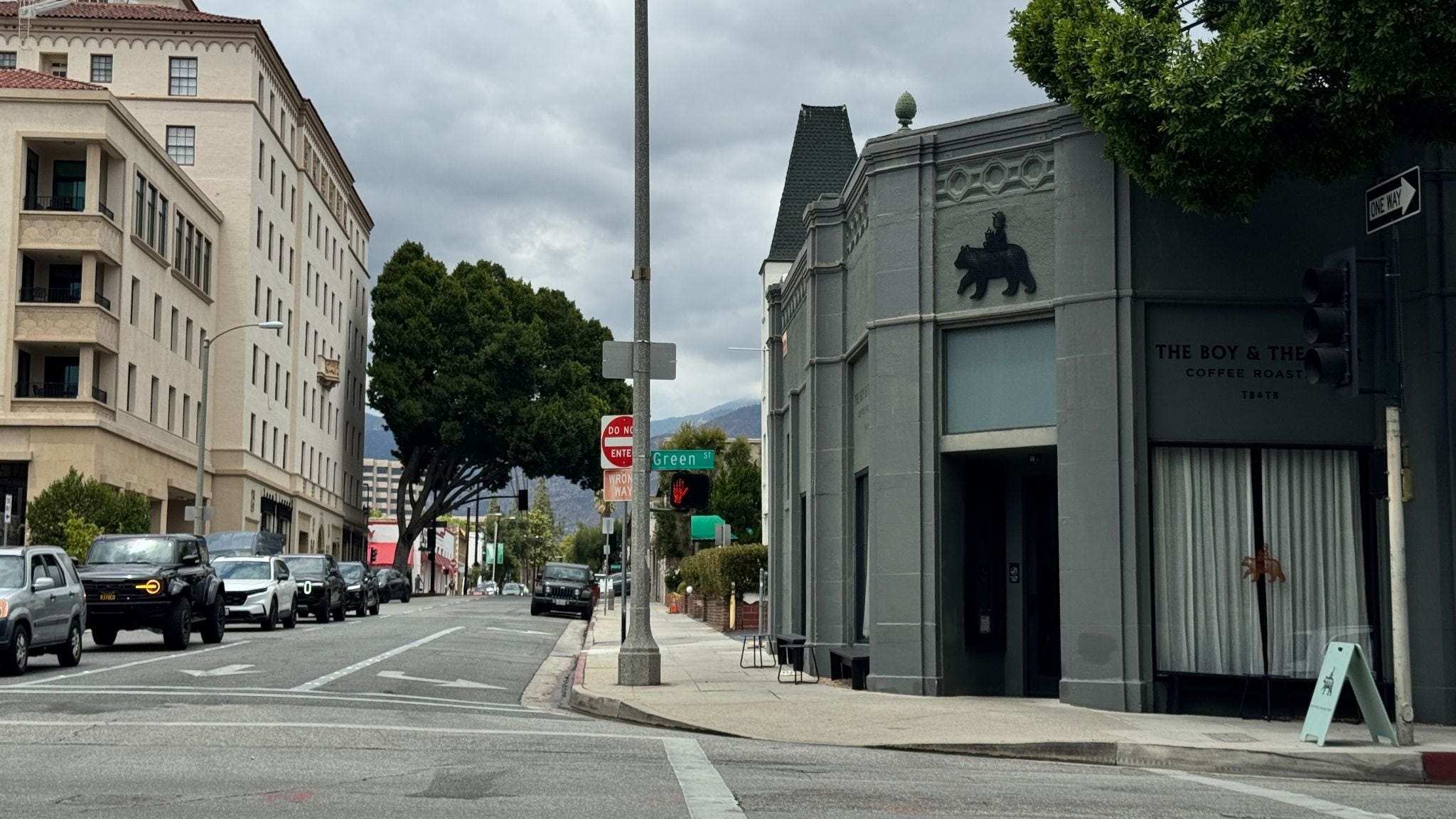
There’s nothing of particular note here at 951 Green Street, and that is exactly why I mention it.
The day is cloudy and warmer than previously recorded May temperatures, and I happen to be here at this coffee shop, enjoying my usual — a flat white with oat milk — and trying to reclaim my sense of place after having traveled abroad for the last month.
Everything is as I left it: Large plumes of a bird of paradise plant jut from the same corner where jungle drum & bass booms from a speaker. A man in cargo shorts and flip-flops stands waiting for his drink. The sounds of milk steaming, cups clinking, and life hurrying along, none the wiser about my absence or return.
It’s the familiar hum of a life I’d stopped noticing until I re-entered it. And strangely, one that offers very little in the way of comfort at this moment. Because despite the complete normalcy in front of me, something uneasy hangs in the air: a low, prickly dread that settles in the body before thoughts can assemble.
It may be from the headlines reminding us every day that both progress and awful things are happening. From the way each visit to the grocery store and gas pump shows how little is within any of our control. Or it may simply be that I am worried about what comes next.
An essay.
It had been months since the last, and many months before that one. At this point, the instinct to begin another feels increasingly difficult to separate from a blooming fear that if I stopped writing for too long, I might lose some remaining essential part of myself along with it.
I know this is an ordinary writerly concern, but so are: What the hell do I write about next? What if this idea isn’t any good?
What if I disappeared and no one cared?
And well, here we are.
Of course I have inklings of what this essay could be. Writing, I’ve come to realize, is a bit like playing a game of hot and cold. I’d have a go at it with plenty of false starts and a cursor that blinks for minutes at a time and feel around until things get warmer, colder, warmer again, and...I don’t know.
What I do know is that I always have these inklings. An intuition, if you will, of what something wants to be. Just like I did when I published an essay last year about my reinvention, when I dismantled a life driven by status, validation, achievement, and ambitions that were never mine to begin with — and started all over. Not merely to leave, but to return. To finally make good on the promise to return to writing I made to myself so many years ago.
I described the process in over 5,000 words as “a fight, a long drowning,” and before I even finished the writing, I had already been pulled under.
Specifically, I want to call attention to this quote:
And for the first time in my life, I could no longer say yes to the old gods.
Not because I didn’t want ambition, money, status, or recognition. It was because my creative integrity now demanded it. It demanded that I choose silence over spectacle. To choose intention over desperation. And to choose myself over selling my soul for speed.
Even if there was no guarantee anything would come of it.
It’s easy to see the beginnings of things.
It’s easy because you could romanticize the beginnings — without ever seeing the ending. I can remember with stunning clarity the conviction I felt to begin anew, with a different way of creating than I’d allowed myself before: a reinvention all the same. I imagined long mornings at the keyboard, freed from the old dread and bargaining rituals that had governed my work for years.
I imagined myself waking up one day, long after the adrenaline had worn off, and finally feeling lighter and unburdened by the demands of schedules and my own expectations. So certain I would be that I’d recognize an end once I reached it.
I come to you now a year later — with 55,684 total words published (I tallied the word count) across seven written essays and three video essays — to say that I’ve lost track of an ending. If there ever was one.
I remember walking to a coffee shop on a weekday afternoon. There was no one else to meet that day, nor the day after. Nothing pressing needed to be done, not until the next essay. I got my usual espresso drink and watched the baristas move in a blur, serving customers rushing in and out during their work breaks. And in that moment, while calmly sipping my coffee, I knew that I had reached the mirage.
By now I’ve reinvented myself enough times to know every way of living eventually asks something from you, and I figured that I was resourceful enough, tough enough, to absorb whatever this version of life demanded too.
I now wonder how anyone who has seen reinvention’s true cost would let it be so gilded.
The mornings are longer and lighter, yes, but the reality is much less spectacular, much more unending than I imagined. The old dread has simply changed clothes. The bargaining rituals are still there too, smiling like a wolf. “No pressure,” I tell myself, already knowing that there is pressure.
Each time I hit publish on an essay or video, it carried with it the faint hope that it would be the One, the one to make me feel as though I had crossed an imaginary finish line. That my reinvention was nearing its end, and although I had previously written that I knew there was no such thing, I realize now that I still secretly wished there was. Because then this weird, liminal period could just be the load time before my new life could really begin. Was there anyone ever so wrong?
Yes. Yes, there was.
Whereas back in my old ways, there were deadlines to chase, standards and metrics to meet, and people always waiting on the other side of work. For decades, my life had been built around maximizing forward motion: The next milestone, a higher revenue goal, the best version of myself — each always “over there.”
The old ways offered me something: structure, praise, and measurable progress. It also gave me movement, even if it was sometimes poison.
Most of all, it gave me evidence that a life was being lived.
This way gives me something different entirely:
The ordinary, unspectacular daily ache of weightlessness.
Sometimes I find myself caught between the relief of possibilities and all this spaciousness, and a sudden terror that there’s too much of it.
With nowhere urgent to be and no one expecting anything from me, it often feels as if life has been postponed and I’m just playing house in the meantime. Ambition does not seem to fade from the body as easily as it does from the mind.
The days are filled with me, just me alone and my own plodding rhythm, and lots of periods of waiting. Waiting, mainly for the next piece of work to pour out of my head. Oftentimes that means being on the couch, antsy over how long the waiting will last this time, wondering if the plants need to be watered or if stillness means failure.
Isn’t this the form of freedom so many people imagine wanting? The absence of meetings, bosses, deadlines, revenue targets, growth loops, and demands?
What people mention less often is how these make up the vertebrae that prop up your life and, once they’re gone, how disorienting it becomes when Monday feels undifferentiated from Tuesday or Friday, or even the 1st of June. When time marches on regardless.
This, too, was something I had already written about in an essay on productivity withdrawal. In it, I said:
Time feels different in the stillness of nothing.
No matter how precise the systems for excellence and freedom, time remains untamed. It’s neither chaotic nor kind.
It’s just indifferent.
Whether you’re sprinting or stalling, rising or ebbing, it doesn’t wait. It doesn’t care.
And that… that coldness —
Maybe that’s what I’m still learning to live with.
Yes, maybe that’s it: Learning to live with the coldness of time. Even a year later.
How strange.
It’s not as if there’s anything wrong — and that’s just it: Nothing appears wrong from the outside. Groceries are bought, laundry done. The emails and texts are received and answered (though not necessarily when I get them but eventually), and the work continues until the beginning stops feeling like a beginning at all. The days simply pass, one after another.
I set out at the start of my reinvention to be a writer once again. And I did that, I think. Do 10 pieces of work over a year count?
Whether or not I publish enough might just seem trivial, but of course it’s more than that: A year is 12 months, four quarters, and one Super Bowl — a reasonable amount of time to have made enough of something to point to, should anyone ever ask.
I remember being at a friend’s 40th birthday party, trying to answer the dreaded “what do you do?” question, and finding myself searching for loftier phrasing to replace “Writing for myself on a platform called Substack. Oh, you haven’t heard of it...?” As if I had to justify my work’s existence and therefore my ownership of it. If it could even be possible, I feel less writerly now than I did before committing to it full-time. Don’t the 10 pieces of work so far mean anything?
Each piece of work breaks the blur long enough to feel like I still have a place here. Which, in lieu of the more legible markers of adulthood like a recognizable career or business, has become my new proof of aliveness.
No pressure, yeah?
Perhaps it is the old ghosts of productivity that believe a life must constantly produce visible evidence of itself.
Or perhaps it is the whisper of a buried identity that constantly asks, “Are we there yet?”
Ah, the mere mention of this emotionally familiar question stirs a certain déjà vu from my first video essay on fitness.
This video appears on the surface to be a straightforward “before” and “after” transformation story spanning 10 years. But what looms over the video the entire 44 minutes is this growing disillusionment of believing that life begins after the goal is reached. I reflected:
The goal itself wasn’t the problem.
The habits I built weren’t the problem.
The problem was the belief that things like happiness, confidence, self-worth were all things that were waiting for me at the finish line.
That once you get there, the yearning disappears and the search for the end along with it.
What I’m feeling in this reinvention is the stretch of time where I’ve made my choices and named the thing intellectually, but it’s the body that is burdened by the weight of inhabiting every day without anyone confirming I’m doing it right. Or sheepishly reminding me, “Hey, you’ve seen this problem before.”
Because I have.
My essays — on reinvention, on productivity, on fitness — have mapped these exact psychological patterns. And here I am now, feeling slightly embarrassed to wonder yet again if there’s a new “after” to even reach.
Turns out you have to relearn that lesson every time life changes shape. Funny how that works. Funny how prior knowledge doesn’t save you from yourself.
Re-reading them, the essays now seem stranger, more prophetic. I thought I was writing about reinvention, about productivity, about the body. But it’s become clear to me that I had only understood them partially.
When I wrote that reinvention is “the death of clinging to certainty...and who you thought you were,” I don’t think I understood then how long a death could continue dying.
When I said in my fitness video, “I had already won. It just took me 10 years to realize it,” I don’t think I understood then that I carried the very same fantasy of an invisible destination into this reinvention.
And when I wrote that productivity withdrawal was not from productivity itself, but from “the identity that wrapped itself around the output and the schedules full of doing,” I don’t think I understood then that being productive was not the only thing I was trying to give up.
And what I was trying to give up, and failing to do so, was the need for visible proof that a life — one that was acceptable by modern standards — was truly occurring.
How do you recognize a life?
When can I see my work and understand it to mean “living a life” — and not merely the one I left behind?
I could see now that each essay was less interested in transformation than I once thought. All these essays, this one included, keep returning to the same ideas that dominate my current reality: drift, silence, uncertainty, and the ever-present question of how to live now.
How indeed.
Back then, it was obvious: Do more. Make more. Be more. Achievements defined the edges of a life. The chase was the life, and to stop striving felt alien. What else was there to organize your life around?
In the beginning, I did not understand what this essay would be. I thought it would be about art as an act of endurance. Of returning to the writing chair to struggle, again and again, convinced that I’ve got the excess masochistic tendencies to do so. I thought it would be about the fear that nothing in my life has changed, or that everything has changed.
Nothing and everything can both feel true at once.
Most days do not appear transformed. They are still tied to familiar anchors: coffee walks, errands, notes for future essays buried in documents, workouts, dishes in the sink. A montage so unwatchable, so small in increments that it looks nothing like reinvention.
In fact, for a long while I mistook this for the most terrifying affliction of the modern professional: stagnation. For without the structure, validation, and legibility of the old ways, it’s hard to tell if life is sprinting or stalling, rising or ebbing. I mostly just feel off the map here, in this inglorious period after the beginning, where I’m still expecting to go somewhere, still expecting to become someone.
Without the old ways generating momentum, movement feels different. Less measurable, less obvious.
But then, some time ago, I met an Uber driver who had retired from a 37-year career only eight months prior and told me he was “just doing this for fun.” Told me it was better than “sitting at home and doing nothing.” I cannot imagine the psyche of someone who believes spending an hour just to crawl through nine miles of Los Angeles traffic to be “fun,” but I can imagine that driving all over the city may be his way of reclaiming movement in a life that no longer has it but still craves it.
Perhaps I’m not so different from him. Perhaps we’re both trying to outrun the same daily ache of weightlessness. For him, it’s driving strangers through Los Angeles. For me, it’s writing.
I thought leaving the old ways would be freedom, but instead it often feels like becoming unrecognizable to the systems that once reflected back my existence to me. Writing then is one of the remaining ways I know how to perceive the continuity of a life.
And how to avoid disappearing.
Every essay I’ve put out so far has really been a record-keeping of a different kind of existence — long before I saw what they were. Like ideas circling and waiting until the moment they crossed over from the mind to lived experience. Intellectually, I had understood these ideas. I felt them too as I wrote them. But living them — and continuing to — has required something harder than understanding.
Reinvention was not really about becoming someone new, but grieving the person I thought I needed to be.
Productivity withdrawal was not really about work, but discovering how much of my identity had fused itself to output, usefulness, and proof.
And the fitness essay — despite all its talk of goals and transformation — was really about how the fantasy of the “after” is bottomless.
Now as I write this, looking back at the ordinariness of life, I see what this essay has been waiting to tell me all along:
A different life had already arrived.
So imperceptibly I barely noticed.
Life is already here.
I’ve written essays, made work I’m proud of.
I’ve traveled and attended weddings and baby showers.
I’ve gone through cancer treatment. I’ve (on many attempts) changed my relationship to work and ambition with varying degrees of success.
They all felt like drifting so gradually you only realize much, much later that you’re already so far from shore.
Which is precisely the same lesson I’d learned from my fitness transformation — but I’d forgotten. How one year can become 10, and how you can enter a revolving door one way and come out a whole lot different, with a different body, different fears, different desires, without ever remembering the exact moment the change occurred.
It’s awkward to admit that I couldn’t see, until now, that the reinvention had been happening all along. Just slower, stupider, and far less spectacular than anyone ever cares to admit.
When you no longer have movement, you forget how to recognize a life.
In my mind I was always just passing the time for another week or another month, releasing work enough times until a bigger, grander revelation would hit me.
But all along, life had been moving and shifting and accumulating, with me none the wiser. I only knew to recognize the beginning of a life, but was embarrassingly less skilled at recognizing the long middle part of actually living one.
One where I decide to make coffee at home or go to this same coffee shop playing jungle drum & bass (or do both). A life where I tell myself to write and just see what happens, even if no one expects me to.
Where the work may never justify itself in the ways I once hoped it would, and the change I’ve been looking for all this time is sticking with it despite the frightening possibility that there may be no reward or “after.”
A life can already be happening while you’re still waiting for it to begin.
Freedom, it seems, is really the distance between endings and beginnings.
And that distance is perhaps what I’ve been trying to learn how to recognize this whole time.
"That my reinvention was nearing its end, and although I had previously written that I knew there was no such thing, I realize now that I still secretly wished there was." I feel this so hard. Always searching for the finish line only to come to the conclusion that there isn't one and life is to be lived not waited. Keep writing! You have such a gift.